Emiza Supply Chain Platform

OVERVIEW

Emiza is a logistics platform unifying warehouse operations, fleet tracking, billing, and planning workflows — built from scratch to replace a US off-the-shelf solution that didn't fit India's on-ground realities. The result: ~86% less revenue leakage and 70% fewer support calls.

YEAR

2018

ROLE

UX Researcher & UI/UX Designer

About the project

On-site at the Delhi warehouse, we met a wall of skepticism — staff had watched software come and go, and some saw it as a threat to their job security. Before designing anything, we earned trust: two days working alongside the team, moving boxes, sharing chai and jalebis. That unlocked contextual inquiries and interviews across 6 user groups, and one reframing insight — technology wasn't the blocker, distrust was. Every solution answered a single question: what will help this person feel in control, not exposed?

I designed a split ecosystem — a web app for planning, monitoring, and support, and a mobile app for pickup, delivery, loading, and unloading — with eight targeted workflows: guided task flows and gamified accuracy incentives for ground staff, a smart-notification "single source of truth" replacing phone-call chases, small-step training flows with offline access for a high-churn workforce, a low-cost barcode seal system preventing malpractice without surveillance, a drag-and-drop planning board replacing WhatsApp and whiteboards, trend-based dashboards for regional managers, billing linked directly to shipment statuses, and end-to-end consignment tracking with proactive alerts.

Business impact: revenue leakage down ~86%, support calls down 70%, higher app adoption with lower training dependency, and real-time visibility across the org. Emiza became Airtel's fulfilment partner for India, distributing the iPhone X.
Problem

There’s almost a million of parking spaces in Housing & Development Board (HDB) estates across Singapore. HDB has been relying on a legacy digital system that has not been iterated on for over a decade. Officers overseeing the parking infrastructure have been dissatisfied with the manual processes and unreliable user experience. With increasing demands on parking management and evolving technological capabilities, there was a clear need to modernize the system.

Highlights

re

Discovery

Stakeholder Interviews

User Interviews

Heuristic evaluation

Strategy

Guidelines & libraries

Brand Expressions

Design System

Design

Information Architecture

User Flow & wireframe

Evaluative research

Phase 1

Phase 2

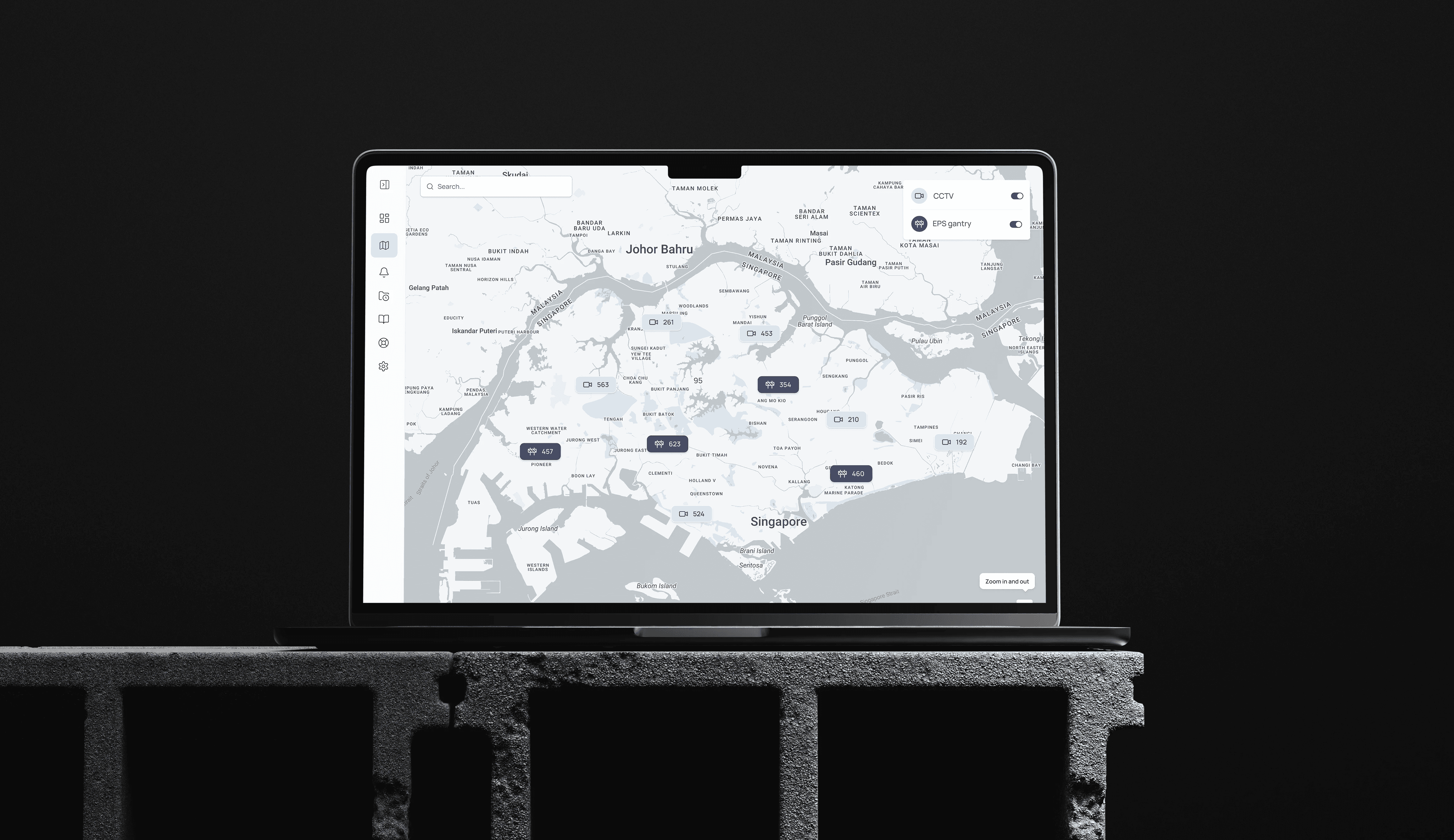
Map: Before implementation, officers relied on pdf maps or had to visit specific car parks to determine where CCTVs and gantries were located

Lots allocation

There are many types of parking lots, and officers reported that there was no overview of what kinds of lots specific car parks have

Data visualization

To improve consistency and efficiency of the design system,
I was responsible for creating new components that were used by other designers and engineers

Retrospective

What I would do differently: I would advocate for implementing sprint-based work during the discovery stage to better manage workload and deadlines. Instead, we only adopted sprints once engineering investigation and implementation began.

Lessons: This was my first project with a government client, and I discovered that government operations differ fundamentally from those of tech companies. While private sector projects are driven by business impact and scale, government projects prioritize public officers' and residents' satisfaction. Instead of focusing purely on business metrics, the emphasis is on creating smooth operations and positive experiences for both civil servants and residents.

Tradeoff: One of the calculated risks I helped the team decide on was using an open-source design system instead of building our own. I partnered with an engineering lead to choose the most flexible and usable option for our project. This approach allowed us to focus on solving real officers' problems rather than reinventing standard components. The team's velocity improved significantly, though we occasionally had to work around the design system's limitations to meet specific requirements.

Emiza Supply Chain Platform

OVERVIEW

Emiza is a logistics platform unifying warehouse operations, fleet tracking, billing, and planning workflows — built from scratch to replace a US off-the-shelf solution that didn't fit India's on-ground realities. The result: ~86% less revenue leakage and 70% fewer support calls.

YEAR

2018

ROLE

UX Researcher & UI/UX Designer

About the project

On-site at the Delhi warehouse, we met a wall of skepticism — staff had watched software come and go, and some saw it as a threat to their job security. Before designing anything, we earned trust: two days working alongside the team, moving boxes, sharing chai and jalebis. That unlocked contextual inquiries and interviews across 6 user groups, and one reframing insight — technology wasn't the blocker, distrust was. Every solution answered a single question: what will help this person feel in control, not exposed?

I designed a split ecosystem — a web app for planning, monitoring, and support, and a mobile app for pickup, delivery, loading, and unloading — with eight targeted workflows: guided task flows and gamified accuracy incentives for ground staff, a smart-notification "single source of truth" replacing phone-call chases, small-step training flows with offline access for a high-churn workforce, a low-cost barcode seal system preventing malpractice without surveillance, a drag-and-drop planning board replacing WhatsApp and whiteboards, trend-based dashboards for regional managers, billing linked directly to shipment statuses, and end-to-end consignment tracking with proactive alerts.

Business impact: revenue leakage down ~86%, support calls down 70%, higher app adoption with lower training dependency, and real-time visibility across the org. Emiza became Airtel's fulfilment partner for India, distributing the iPhone X.
Problem

There’s almost a million of parking spaces in Housing & Development Board (HDB) estates across Singapore. HDB has been relying on a legacy digital system that has not been iterated on for over a decade. Officers overseeing the parking infrastructure have been dissatisfied with the manual processes and unreliable user experience. With increasing demands on parking management and evolving technological capabilities, there was a clear need to modernize the system.

Highlights

re

Discovery

Stakeholder Interviews

User Interviews

Heuristic evaluation

Strategy

Guidelines & libraries

Brand Expressions

Design System

Design

Information Architecture

User Flow & wireframe

Evaluative research

Phase 1

Phase 2

Map: Before implementation, officers relied on pdf maps or had to visit specific car parks to determine where CCTVs and gantries were located

Lots allocation

There are many types of parking lots, and officers reported that there was no overview of what kinds of lots specific car parks have

Data visualization

To improve consistency and efficiency of the design system,
I was responsible for creating new components that were used by other designers and engineers

Retrospective

What I would do differently: I would advocate for implementing sprint-based work during the discovery stage to better manage workload and deadlines. Instead, we only adopted sprints once engineering investigation and implementation began.

Lessons: This was my first project with a government client, and I discovered that government operations differ fundamentally from those of tech companies. While private sector projects are driven by business impact and scale, government projects prioritize public officers' and residents' satisfaction. Instead of focusing purely on business metrics, the emphasis is on creating smooth operations and positive experiences for both civil servants and residents.

Tradeoff: One of the calculated risks I helped the team decide on was using an open-source design system instead of building our own. I partnered with an engineering lead to choose the most flexible and usable option for our project. This approach allowed us to focus on solving real officers' problems rather than reinventing standard components. The team's velocity improved significantly, though we occasionally had to work around the design system's limitations to meet specific requirements.

Emiza Supply Chain Platform

OVERVIEW

Emiza is a logistics platform unifying warehouse operations, fleet tracking, billing, and planning workflows — built from scratch to replace a US off-the-shelf solution that didn't fit India's on-ground realities. The result: ~86% less revenue leakage and 70% fewer support calls.

YEAR

2018

ROLE

UX Researcher & UI/UX Designer

About the project

On-site at the Delhi warehouse, we met a wall of skepticism — staff had watched software come and go, and some saw it as a threat to their job security. Before designing anything, we earned trust: two days working alongside the team, moving boxes, sharing chai and jalebis. That unlocked contextual inquiries and interviews across 6 user groups, and one reframing insight — technology wasn't the blocker, distrust was. Every solution answered a single question: what will help this person feel in control, not exposed?

I designed a split ecosystem — a web app for planning, monitoring, and support, and a mobile app for pickup, delivery, loading, and unloading — with eight targeted workflows: guided task flows and gamified accuracy incentives for ground staff, a smart-notification "single source of truth" replacing phone-call chases, small-step training flows with offline access for a high-churn workforce, a low-cost barcode seal system preventing malpractice without surveillance, a drag-and-drop planning board replacing WhatsApp and whiteboards, trend-based dashboards for regional managers, billing linked directly to shipment statuses, and end-to-end consignment tracking with proactive alerts.

Business impact: revenue leakage down ~86%, support calls down 70%, higher app adoption with lower training dependency, and real-time visibility across the org. Emiza became Airtel's fulfilment partner for India, distributing the iPhone X.
Problem

There’s almost a million of parking spaces in Housing & Development Board (HDB) estates across Singapore. HDB has been relying on a legacy digital system that has not been iterated on for over a decade. Officers overseeing the parking infrastructure have been dissatisfied with the manual processes and unreliable user experience. With increasing demands on parking management and evolving technological capabilities, there was a clear need to modernize the system.

Highlights

re

Discovery

Stakeholder Interviews

User Interviews

Heuristic evaluation

Strategy

Guidelines & libraries

Brand Expressions

Design System

Design

Information Architecture

User Flow & wireframe

Evaluative research

Phase 1

Phase 2

Map: Before implementation, officers relied on pdf maps or had to visit specific car parks to determine where CCTVs and gantries were located

Lots allocation

There are many types of parking lots, and officers reported that there was no overview of what kinds of lots specific car parks have

Data visualization

To improve consistency and efficiency of the design system,
I was responsible for creating new components that were used by other designers and engineers

Retrospective

What I would do differently: I would advocate for implementing sprint-based work during the discovery stage to better manage workload and deadlines. Instead, we only adopted sprints once engineering investigation and implementation began.

Lessons: This was my first project with a government client, and I discovered that government operations differ fundamentally from those of tech companies. While private sector projects are driven by business impact and scale, government projects prioritize public officers' and residents' satisfaction. Instead of focusing purely on business metrics, the emphasis is on creating smooth operations and positive experiences for both civil servants and residents.

Tradeoff: One of the calculated risks I helped the team decide on was using an open-source design system instead of building our own. I partnered with an engineering lead to choose the most flexible and usable option for our project. This approach allowed us to focus on solving real officers' problems rather than reinventing standard components. The team's velocity improved significantly, though we occasionally had to work around the design system's limitations to meet specific requirements.

Create a free website with Framer, the website builder loved by startups, designers and agencies.